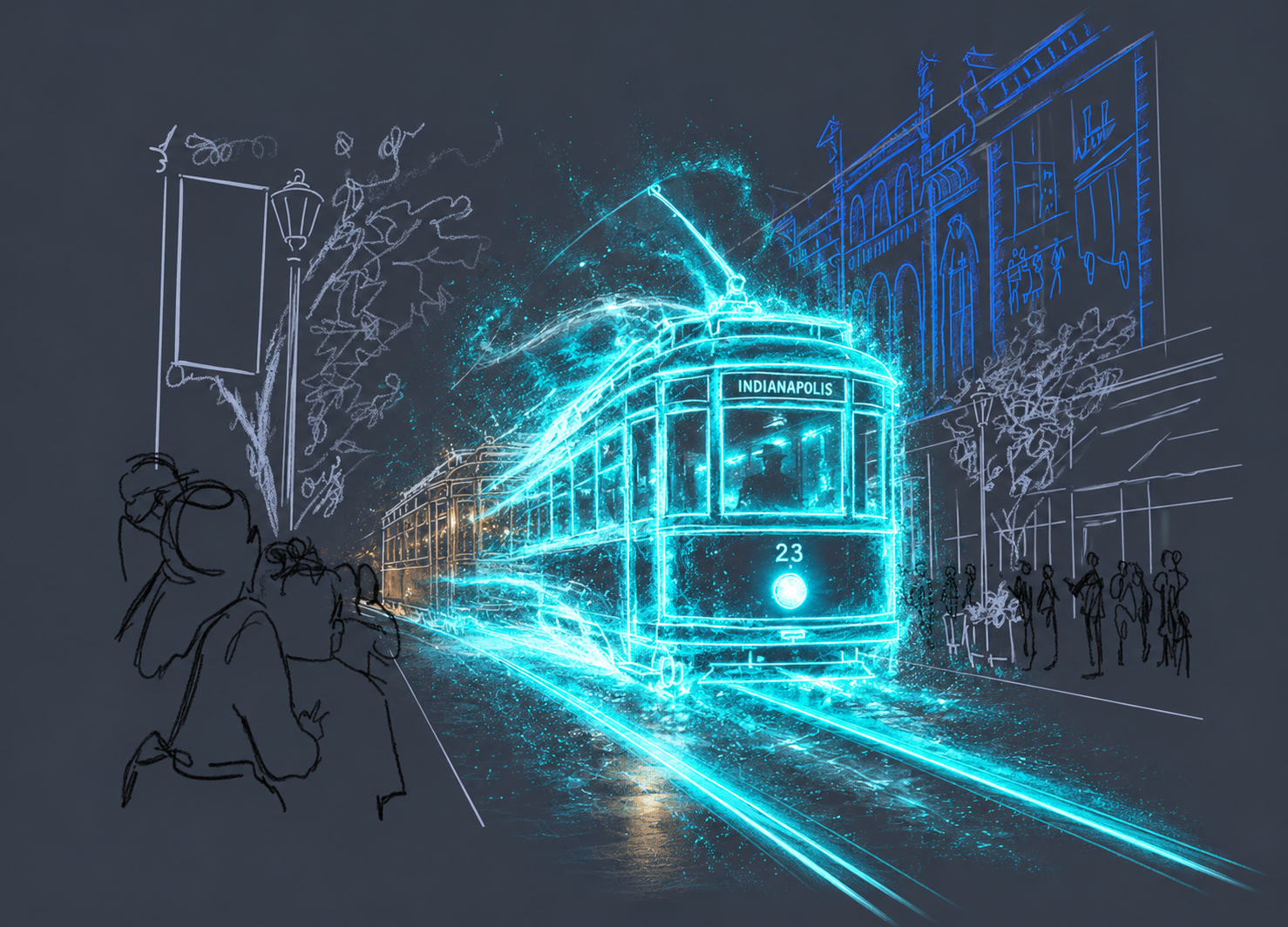
The past, now arriving in the present.
Traction Yards was conceived as a place where the history of Indianapolis could become part of its future. Historic architecture, electric railways, the energy of a growing city—all reinterpreted as a contemporary gathering place.
But what happens after dark?
What if the story we’d built into the architecture could actually come alive? What if the old electric trolleys that once carried Indianapolis into the future could return for one more journey?
Not as a haunted-house attraction. Not as something frightening.
As something beautiful. A little mysterious. And just believable enough to make you wonder what you actually saw.
That became the idea behind Echoes of the Past.
The Trolley Unbound
The experience begins with a restored, turn-of-the-century electric trolley car, sitting quietly on its tracks.
It’s real. Solid. Tangible. A piece of the past brought back into the present.
As evening settles over Traction Yards, the atmosphere begins to change. The familiar lighting dims. A low electrical hum builds. The rails beneath the trolley start to glow.
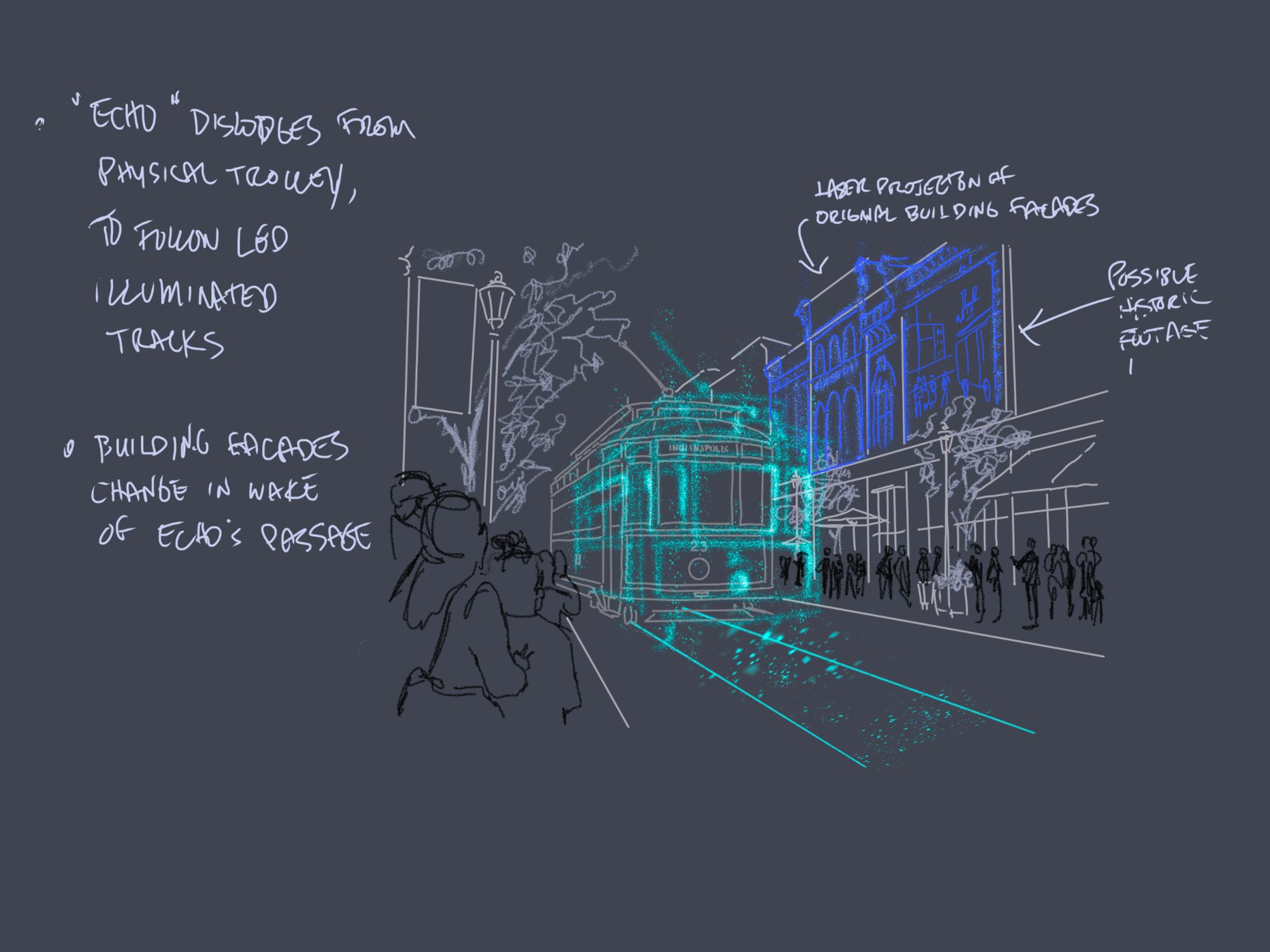
Sparks gather around its wheels, then climb upward, tracing the contours of the car. The electrical energy becomes a shimmering, translucent outline—an ethereal version of the trolley, occupying the same space as its physical counterpart.
Then comes the familiar sound.
Clang, clang.
The glowing apparition lurches forward.
And leaves the restored trolley behind.
The physical car hasn’t moved. It remains exactly where it was, while its spectral counterpart begins traveling down the thoroughfare.
That’s the moment the experience asks guests to accept something impossible.
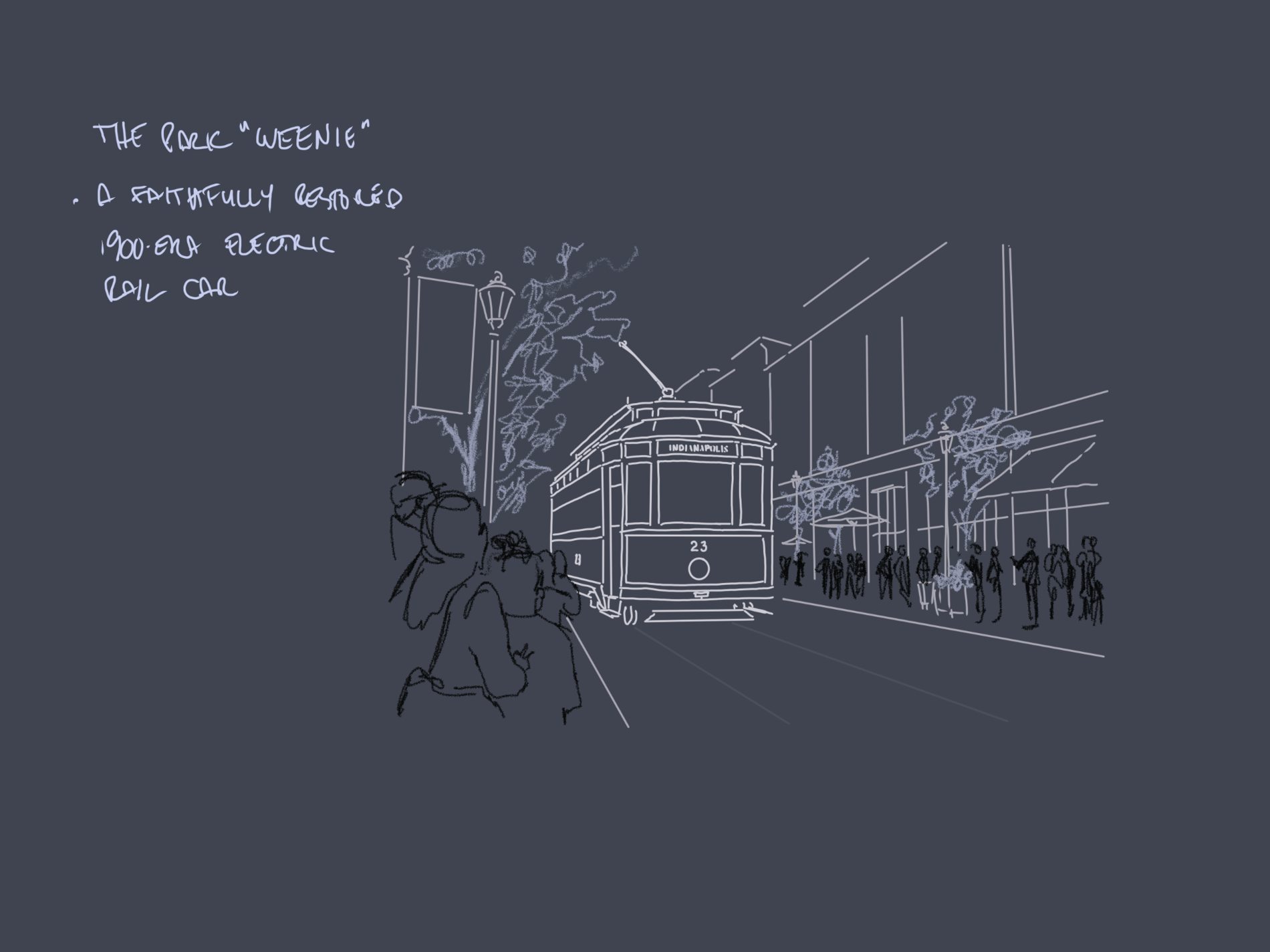
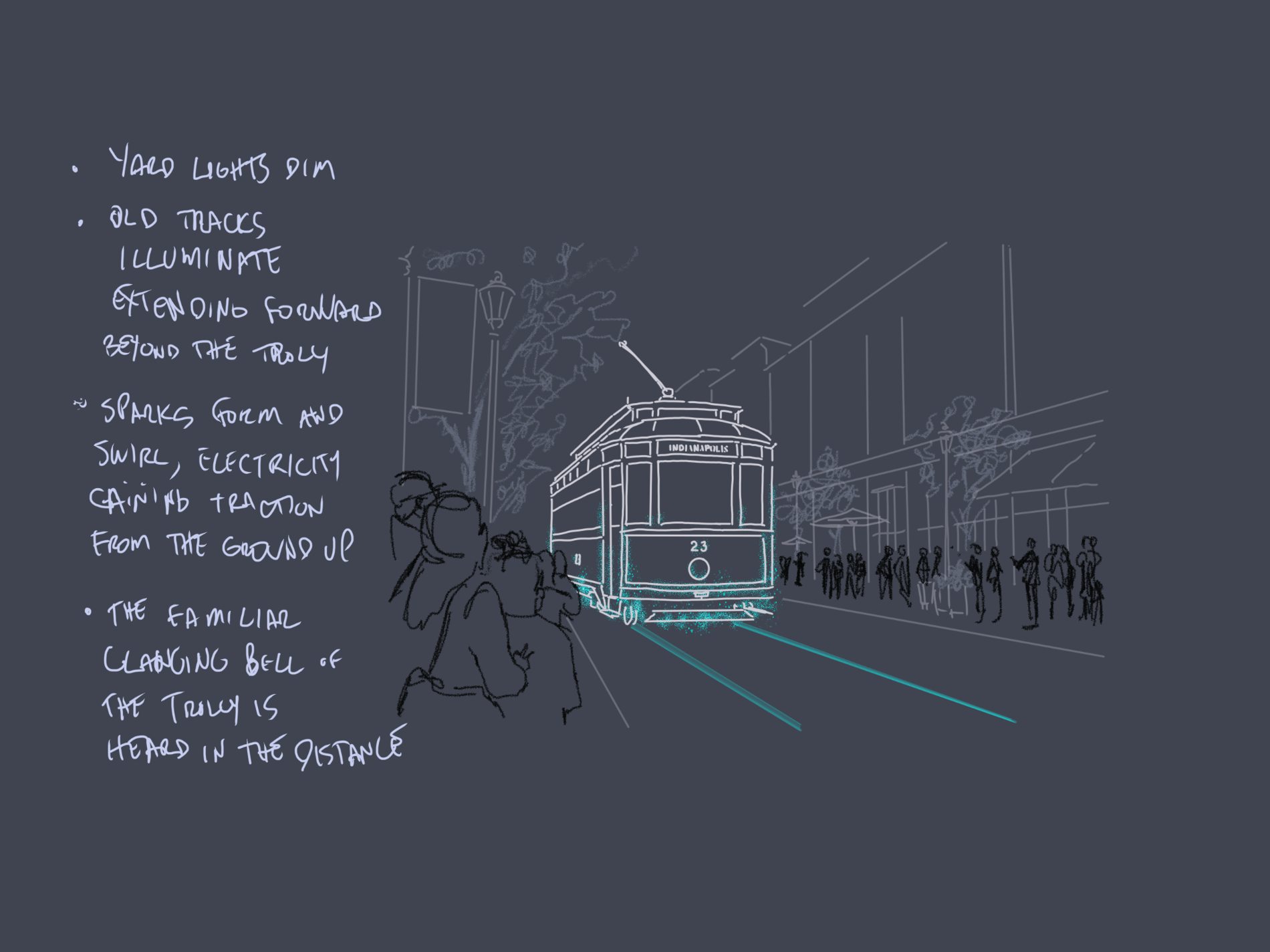
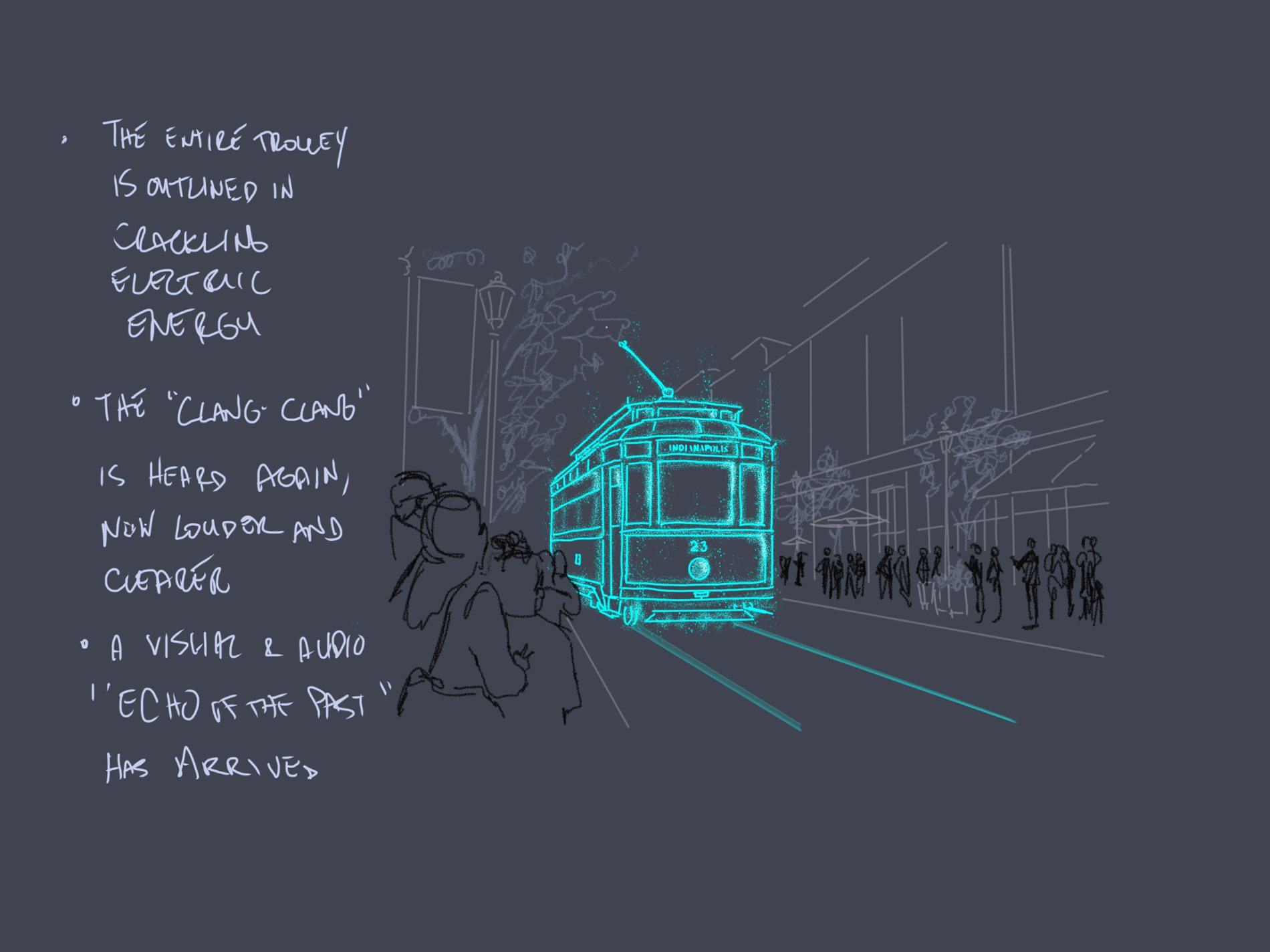
From the original show sequence · Illustrative show concept under development
The Gathering Storm
The streetlights dim to indigo. A century-old Indiana evening emerges in sound as shop-window figures appear and electrical light traces the parked trolley.
The Launch & Staggered Departures
A sharp brake snap and flash announce the spectral trolley separating from its stationary counterpart. Staggered departures bring additional cars into the street.
Thoroughfare Flight & Open-Air Phasing
Glowing trolleys appear on the planter-bed projection surfaces, then disappear across pedestrian gaps. Sparks, spatial audio, and impossible window reflections carry their movement between stations.
The Elevated Bridge Handoff
At the intersection, the car vanishes beneath the elevated walkway. Electrical arcs, overhead sound, and pavement vibration trace its passage until it reappears on the next block.
The Boarding & Final Dispersal
Window characters depart to board, with alternate takes introducing variation. At the end of the journey, the trolley dissolves into drifting light as the Yard returns to the present.
Designing an experience without a single best seat
Unlike a theater attraction, Echoes of the Past wouldn’t have a defined audience area. Guests could encounter it from the sidewalk, from a restaurant, beside a shop window, or while walking through the Yard.
That changes the design problem.
There’s no single camera angle. No carefully controlled seating arrangement. No guarantee that everyone is looking in the same direction when the show begins.
The experience has to communicate what’s happening from multiple perspectives.
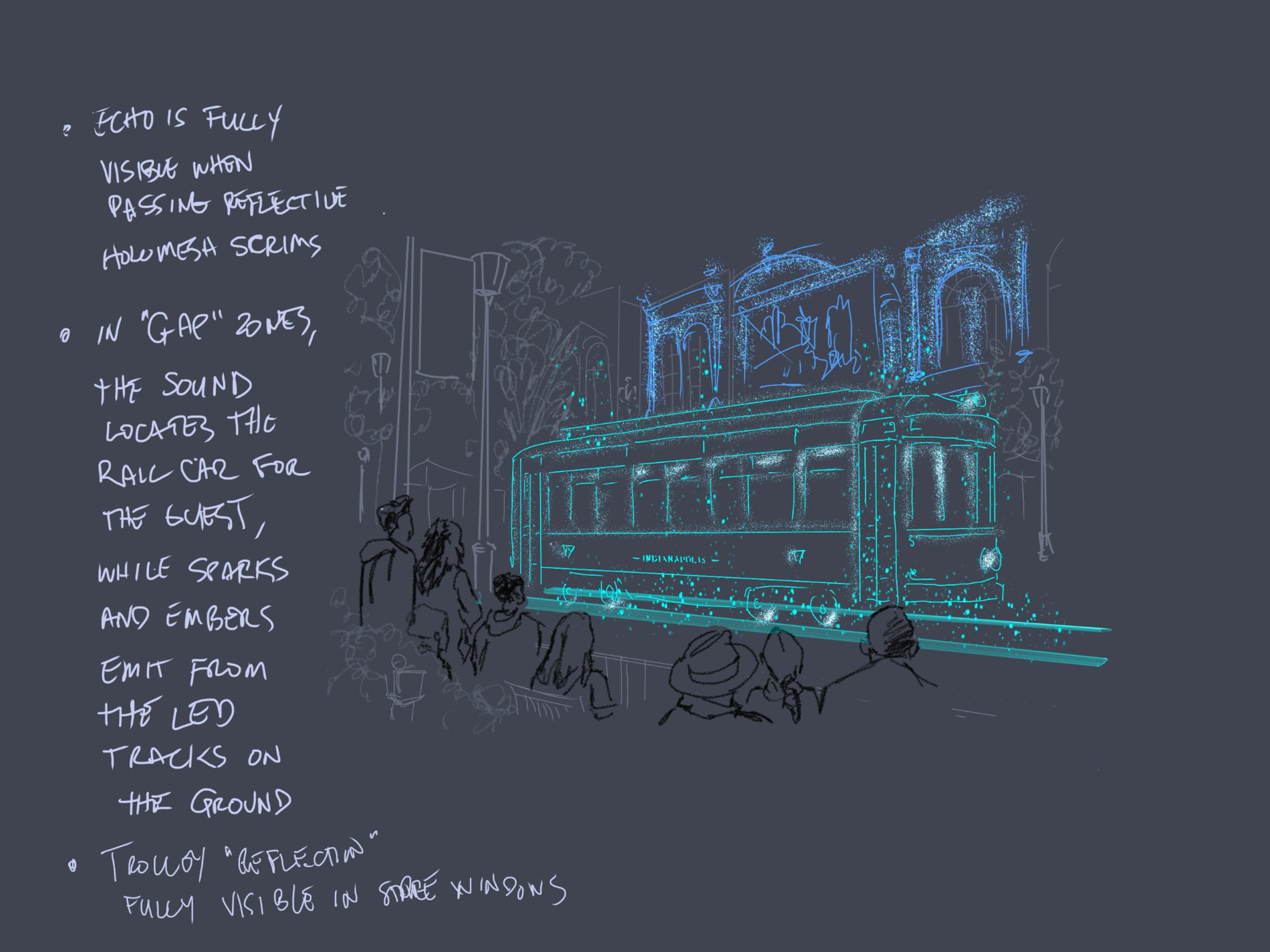
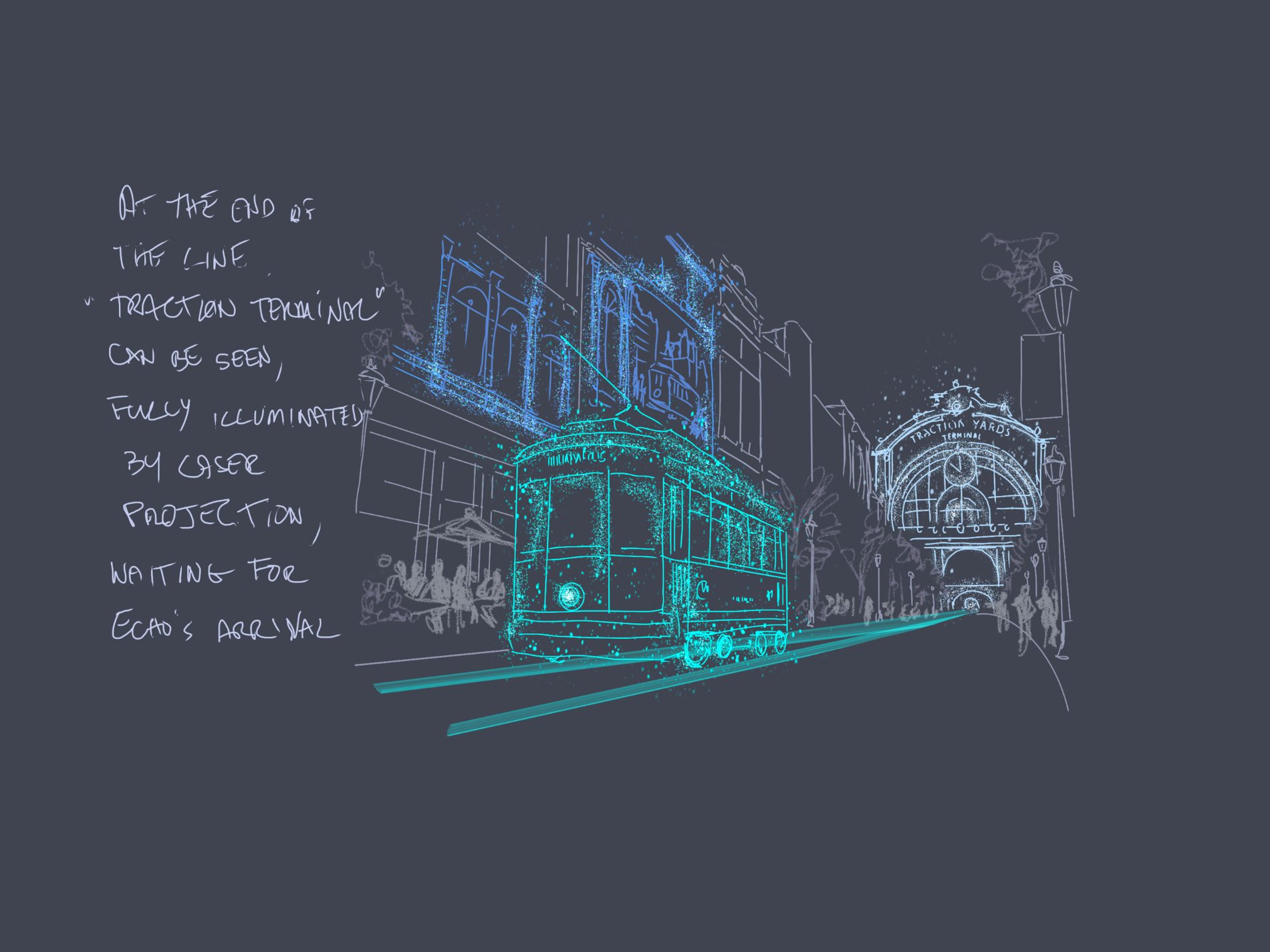
My early storyboards explored those guest-level views: the trolley emerging into the street, its electrical form moving past storefronts, and the surrounding architecture responding to its passage.
The goal wasn’t simply to make a convincing glowing trolley.
It was to make the entire environment participate in the illusion.
How do you follow something you can’t see?
This became one of the most interesting challenges in developing the concept.
I began exploring the possibility of using projection surfaces concealed within a series of landscaped planter beds along the main thoroughfare. Each station could provide a location where the trolley’s three-dimensional appearance might be presented to guests.
But the planter beds couldn’t form one continuous barrier. People still needed to cross the street and move naturally through the property.
Which meant there would be gaps between the projection locations.
And in those gaps, the trolley would disappear.
At first, that sounds like a problem to solve. But it quickly evolved into part of the story.
Rather than struggling with how to make the trolley continuously visible, the experience could embrace its supernatural nature. As the car reaches the end of one projection surface, its glowing form dissolves into electrical energy.
The tracks continue to illuminate beneath its imagined path. Sparks race along the overhead wires. The sound of its wheels, motors, and bell travels down the street, tracking a vehicle guests can no longer see.
And in the nearby shop windows, something even stranger happens.
The trolley appears as a reflection. A kind of reverse-vampire effect. The trolley itself is invisible, but its reflection gives away its position.
Then, as the electrical activity reaches the next planter-bed station, the apparition takes shape again.
The guest has followed the trolley the entire time, even though the trolley hasn’t been visible the entire time.
That’s the experience-design idea at the center of the illusion: continuity doesn’t necessarily require continuous visibility.
It requires a consistent set of cues that the guest can connect into one believable event.
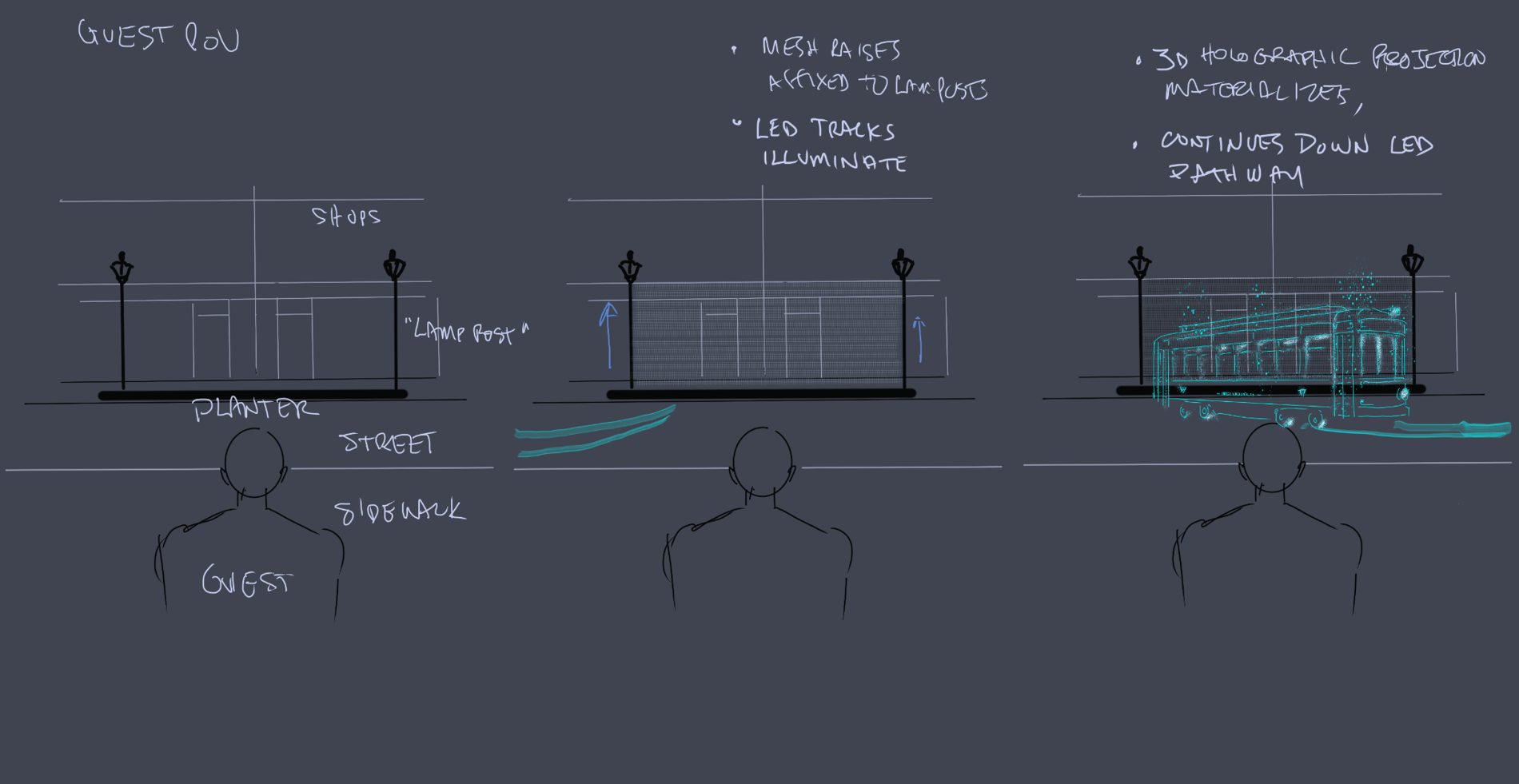
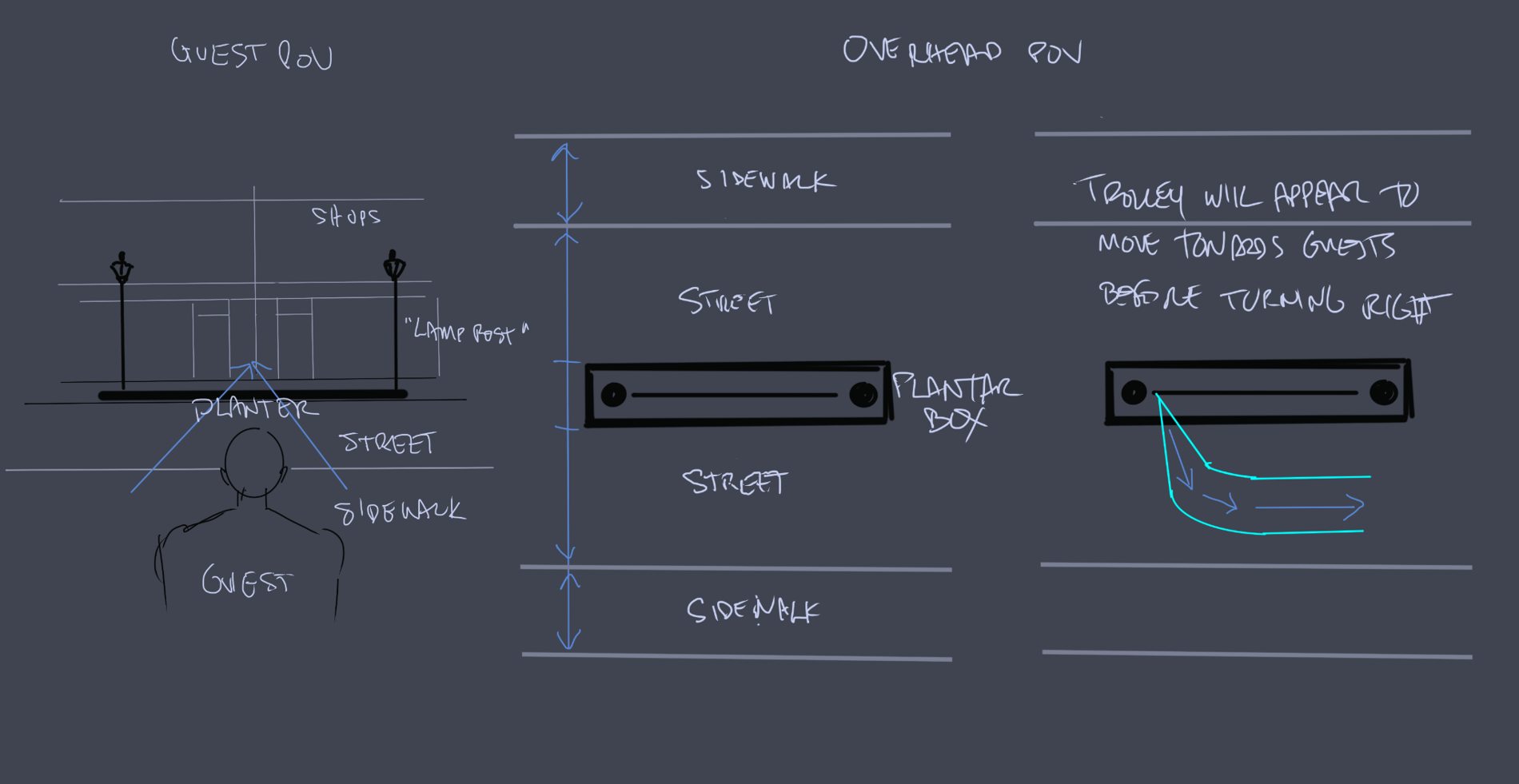
The technical exploration examined a possible equipment arrangement, not an engineered installation. Drainage, waterproofing, sightlines, acoustic performance, and projector safety would all require specialist review.
All aboard! The people of Traction Yards
The trolley itself was only part of the story.
I also wanted guests to discover traces of the people who once depended on Indianapolis’s electric rail network as part of their daily existence.
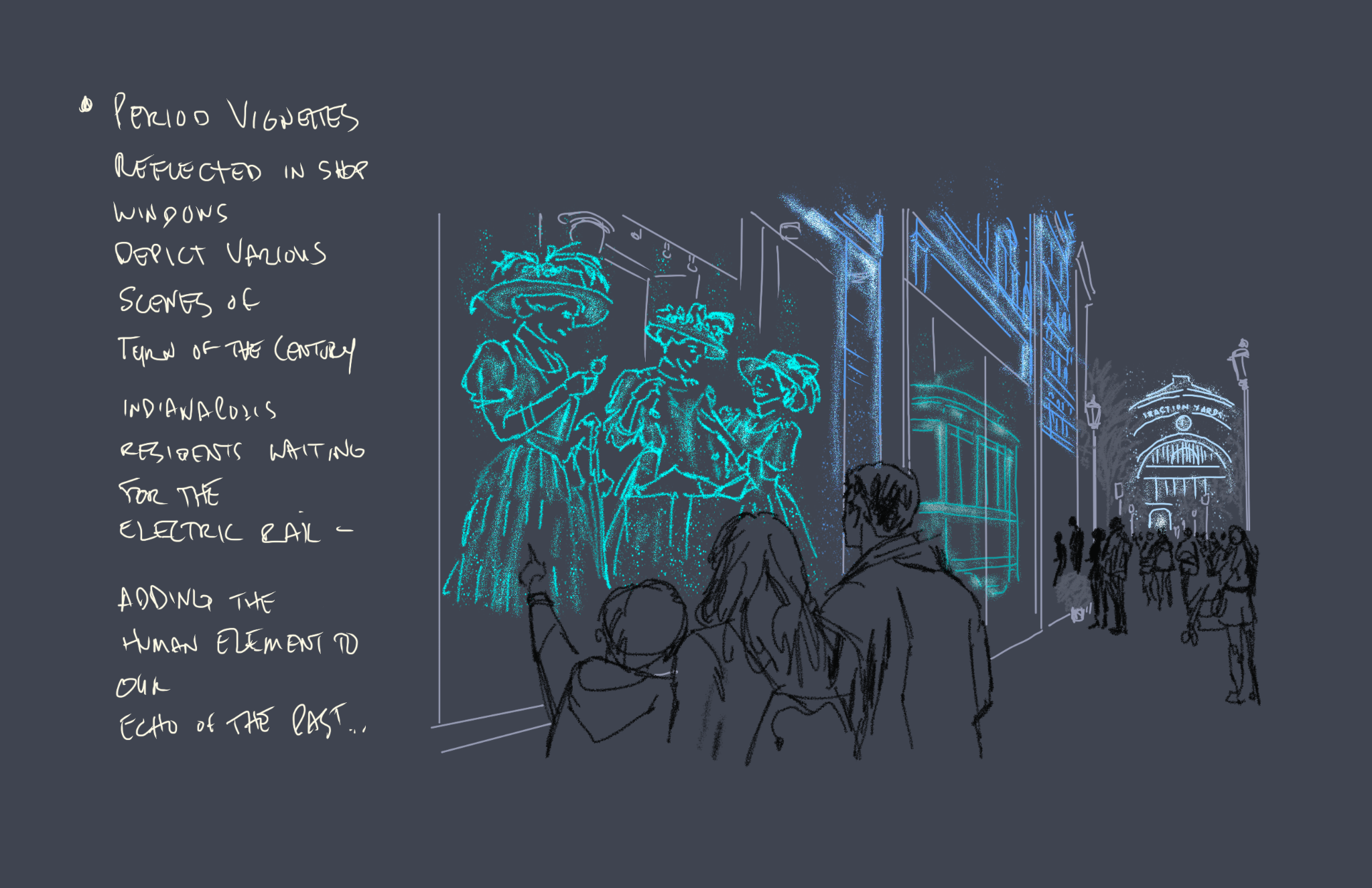
My storyboards imagined period vignettes appearing in storefront windows: figures from another era, briefly visible in spaces now occupied by contemporary shops. A guest might catch a glimpse of someone waiting for a trolley, preparing to depart, or simply going about an ordinary evening.
These would be small moments, rather than lengthy scenes demanding everyone’s attention.
The concept eventually expanded into four possible character groups: Gilded Age socialites, foundry workers finishing a shift, businessmen racing to catch their connection, and traveling ragtime musicians.
Each group had two alternative sequences. Sometimes the socialites leave gracefully. Sometimes they’re so distracted by their shopping that they nearly miss the trolley. Sometimes the foundry workers are exhausted and quiet. On another night, they have something to celebrate.
The intention was to make repeat visits rewarding. A local guest wouldn’t necessarily encounter the same little story every time.
And because these were conceived as non-verbal visual sequences, the action wouldn’t depend on spoken dialogue to be understood. Sound effects and environmental audio could add character without carrying essential plot information.
Exploring the mechanics
I wasn’t approaching this as a projection engineer or a show-control specialist. My background is in graphic, interactive, and experience design.
But I wanted to understand whether the idea had a plausible path toward execution.
So I began investigating possible approaches: LED fans, mist walls, projection mesh, concealed equipment locations, sightline constraints, synchronized lighting, spatial audio, and the relationship between projection surfaces and pedestrian circulation.
I sketched the planter-bed stations from both the guest’s perspective and from above. I explored how a media system might coordinate the appearance of multiple spectral trolleys, and how light and sound could maintain the illusion as each one moved between stations.
I also began thinking about what would happen when more than one trolley was traveling through the Yard. Staggered departures could make the space feel less like a show that happens once and more like a transportation network that has somehow come back to life.
These were preliminary explorations, not validated technical specifications. The actual feasibility, hardware selection, viewing angles, environmental conditions, safety requirements, and costs would need to be developed with experienced technical partners.
But the exercise was valuable.
It forced me to ask questions beyond what the concept art could show. Where would the equipment live? What would guests see from different positions? How would the illusion survive an open pedestrian crossing? And what would happen when the technology couldn’t provide a perfect image?
Those questions shaped the creative direction as much as the storyboards did.
The whole Yard becomes the stage
As the experience progresses, the trolley isn’t the only thing changing.
Building facades begin to suggest their earlier lives. Period details emerge in shop windows. Electric light travels along the tracks. The soundscape moves with the spectral cars, drawing attention from one end of the thoroughfare to the other.
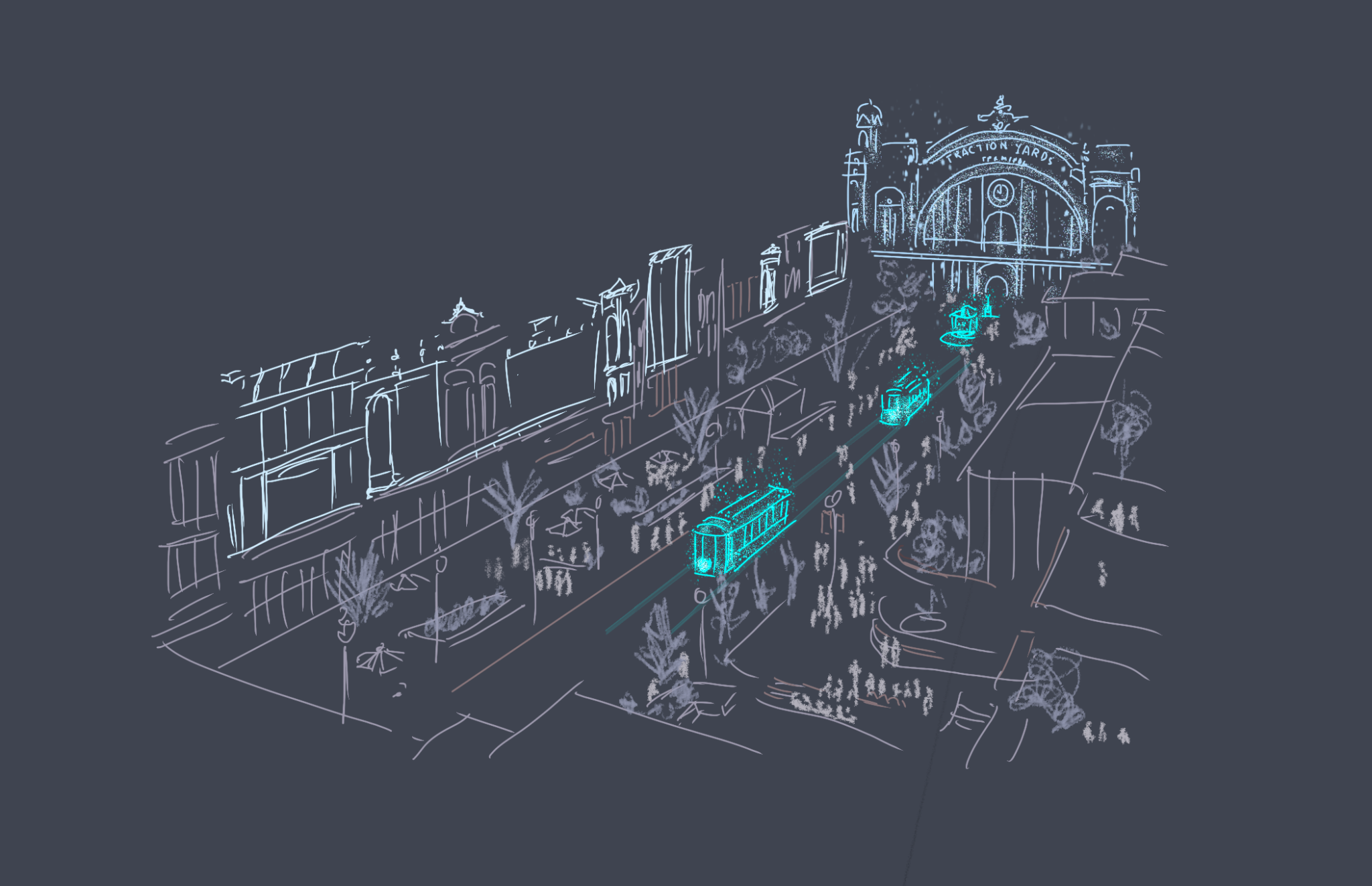
From above, multiple illuminated trolleys can be imagined making their way toward the terminal.
As I worked through the show mechanics, I realized that distributing the effects throughout the Yard could also help distribute the audience.
A single Window to the Past might attract a crowd to one storefront. Four windows, each with its own characters and stories, would give guests different places to gather. Multiple trolley appearances, illuminated tracks, and changing building facades could create additional points of interest along the thoroughfare.
Rather than drawing everyone toward one central spectacle, the experience could encourage guests to explore the entire space.
The more the Yard participated in the story, the less any single location had to carry the show.
The creative brief explored how multiple show elements might be coordinated to distribute both the action and the audience.
The effect isn’t meant to replace the contemporary Traction Yards with a perfect historical reconstruction. It’s meant to let two versions of Indianapolis occupy the same place for a little while.
The city that was.
And the city that’s still becoming.
Destination: A Crossroads in Time
I don’t know whether every element of Echoes of the Past could be realized exactly as I’ve imagined it. That’s a conversation that would require people with much deeper expertise in projection, fabrication, lighting, audio, and show control.
What I do know is what I wanted the guest to experience.
A trolley that leaves its physical body behind. A journey you can follow even when you can’t see it. Fleeting encounters with people who once walked the same streets.
And an entire environment that responds as though the past is still moving through it.
For me, that’s where the design work becomes most interesting. Not in any single effect, image, or piece of technology, but in how all of them reinforce the same idea.
The illusion doesn’t live in the trolley.
It lives in the feeling that you’ve arrived at a crossroads in time—where two different moments in history can exist together, each giving new meaning to the other.